
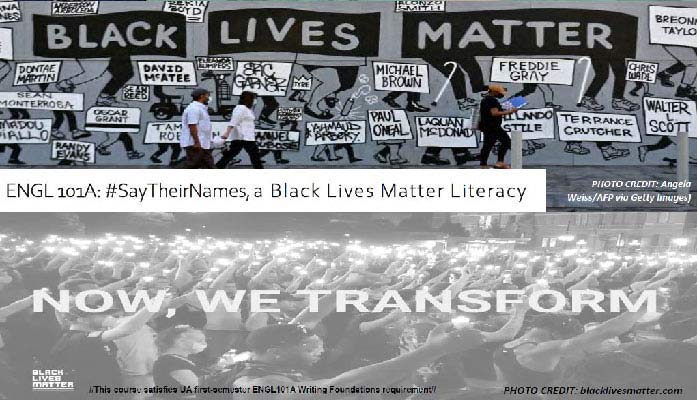
“ENGL 101A: #SayTheirNames, a Black Lives Matter Literacy” is just one of the many foundational writing courses University of Arizona’s incoming freshman can choose to take this coming year.
A flyer created to promote the “ENGL 101A: #SayTheirNames, a Black Lives Matter Literacy” course explains its goal:
By studying American values connected to what we call blackness and whiteness, we’ll explore conflict, contact, and coalition and ask:
●How does social media allow for critiques of race, gender, sexuality, and violence?
●What does it mean to say their names—as an elegy, an anthem, and a language to give space for talking about Black lives?
The goal of this course is to improve your ability to critically think and write. In addition to contextualizing and reshaping the hip hop and #BLM conversations, you will write a personal narrative, which will be inspired by your own language story and possibly, your own social justice. There will be two 75 minute classes and a 50 minute Studio Session once a week. Studio sessions provide further guidance on issues of craft, such as invention, drafting, and revision. Like art studio, Studio creates a learning play space for students to work creatively on projects, become mindful of effective writing habits, and discuss our writings, which are connected to our lives outside of the classroom.
Authors and Texts: TO REGISTER COMPLETE THE BLM Themed Course Request Form or email sev@arizona.edu
The flyer includes a photo at the bottom reminiscent of the Nazi-era in which masses of people are standing with arms held out in front of them in a “sieg heil-type gesture.”
“The 101A course is a foundational writing class for incoming first-year students,” Pam Scott, Associate Vice President External Communications at the University told the ADI. “We offer several sections of 101A and four of them are culturally-themed. This fall we are offering two culturally-themed classes on African American topics and two on Latinx. We are also planning to offer an Indigenous culturally-themed class. These themed classes have been offered for several years and are taught by experienced faculty who understand the content can sometimes be difficult.”
When asked to elaborate on the use of terms “blackness and whiteness,” as well as the definition(s) of “critical” as used in this description, Scott, who was very responsive given the fact that we reached out to her on a Friday of a long holiday weekend, could not provide more information before our deadline.
It appears students are advised ahead of time as to the nature of the courses. Scott told the ADI, “The four culturally-themed classes are described in the catalog in a way that allows students to know that they are signing up for a culturally-themed version of the 101A writing course. This provides students with options with respect to this foundational class.”
It is unclear if this advisory is for the students’ benefit or to dissuade students whose politics might make them unwelcome in such a class.
The stated goals students will work toward in Foundations Writing are:
Goal 1: Rhetorical Awareness – Learn strategies for analyzing the audiences, purposes, and contexts of texts in order to strengthen reading and writing.
Goal 2: Critical Thinking and Composing – Use reading and writing for research, problem solving, critical thinking, action, and participation within and across different communities.
Goal 3: Conventions – Understand how purpose, audience, and context relate to genre conventions such as structure, style, design, usage, mechanics, and citation practices.
Goal 4: Revision – Understand composing processes as flexible and collaborative, drawing upon multiple strategies.
Goal 5: Reflection – Use meaningful, ongoing reflection to inform writing processes, foster the development of a writing identity, and think ahead to future writing situations.
While the culturally-themed classes might incorporate the traditional concept of critical thinking as defined in Goal 2 (see below), the flyer indicates that the courses also rely heavily on Critical Race Theory-based concepts.
Goal 2: Critical Thinking and Composing
Use reading and writing for research, problem solving, critical thinking, action, and participation within and across different communities.
101/107
2A. Integrate evidence through methods such as summaries, paraphrases, quotations, and visuals.
2B. Support ideas or positions by discussing evidence from multiple sources.
102/108
2C. Use a variety of research methods, including primary and/or secondary research, for purposes of inquiry.
2D. evaluate the quality, appropriateness, and credibility of sources.
2E. Synthesize research findings to develop arguments.
2F. compose persuasive researched arguments for various audiences and purposes, and in multiple modalities.
In English 101, according to the University’s website, students will be taught “the social and situated nature of writing—that is, the ways in which writing is tied to purpose, audience, community, and content, and “will write in several genres and analyze how purpose, audience, and context help shape research, organization, and language choices.”
English 101 “introduces primary research methods, including interviews and observations.” Students will be tasked with reflecting on their writing and writing process throughout the course. They will be instructed to submit a final portfolio reflecting on all of their work from the semester.
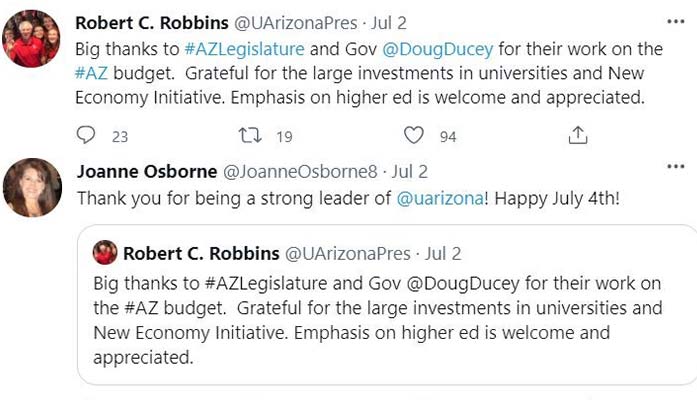
The University of Arizona, and higher education itself, were big winners in the latest state budget, with higher education receiving approximately $2B in taxpayer funding.
“I know the Legislature doesn’t get to go in and pick and choose which courses should be offered, but I think taxpayers would lose their minds if they knew what they were paying for,” one frustrated Southern Arizona parent told the ADI. “We need candidates for Superintendent and Governor who see this garbage and have a plan to do something about it.”
One candidate who may get caught up in the matter is Karrin Taylor Robson, who has spent several years on the Arizona Board of Regents, giving her oversight over the state’s universities.