
On Thursday, the Arizona Auditor General released the second in a series of three audit reports on the Arizona Board of Regents (ABOR) as part of the organization’s mandatory sunset review. The audit looked at whether ABOR’s guidelines governing university-affiliated organizations, such as university foundations and alumni associations, were consistent with recommended practices and the extent to which the universities complied with these guidelines.
The Auditor General also looked at whether ABOR’s oversight “helped ensure university compliance with its guidelines.”
The Auditor General’s concluded: “The universities have not consistently followed ABOR’s guidelines governing university relationships with affiliated organizations, limiting full transparency and accountability for some university resources provided to and the benefits received from these organizations, nor did ABOR regularly receive information on affiliated organization activities.”
According to transaction information the universities provided, in fiscal year 2019, the universities paid $102.8 million to their affiliated organizations for various purposes, including service fees, real estate debt service, expense reimbursements, and return of unused scholarship monies (for more information on the documentation and disclosure of transactions between the universities and their affiliated organizations, see Finding 1, pages 5 through 9). Additionally, according to the affiliated organizations’ audited financial statement disclosures, in fiscal year 2019, the universities provided in-kind resources to their affiliated organizations, such as office space and
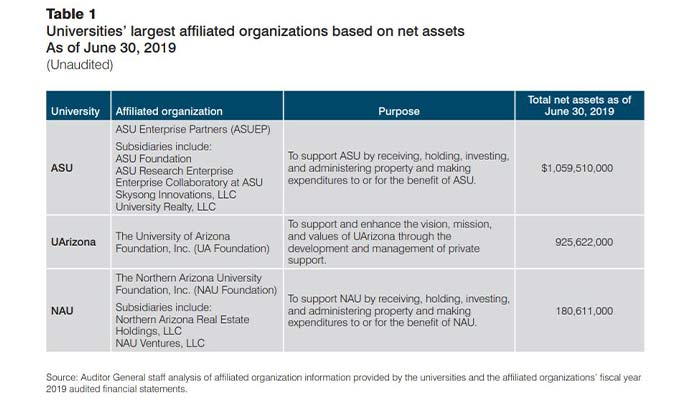
administrative services, with a fair market value of at least $7.3 million.As of June 30, 2019, the universities’ 19 affiliated organizations reported combined net assets of nearly $2.3 billion.”
The Arizona Board of Regents has agreed “with all the findings and plans to implement all the recommendations,” the Auditor General wrote in the audit transmittal letter to the Joint Legislative Audit Committee.
Auditor General Key Findings:
• ABOR defines affiliated organizations as legally separate nonprofit corporations that hold economic resources and carry out activities primarily in support of the universities; and the State’s 3 universities have established relationships with 19 affiliated organizations, including fundraising foundations, real estate organizations, and alumni associations.
• In fiscal year 2019, the universities’ affiliated organizations made $253.5 million in payments to benefit the universities for various purposes, including donations and scholarships, and the universities paid $102.8 million to their affiliated organizations for various purposes, including service fees, real estate debt service, and expense reimbursements.
• Universities lacked current agreements and complete documentation and disclosure of some transactions with some of their affiliated organizations, limiting their ability to demonstrate the public purpose of university resources provided to these organizations and hold them accountable for providing expected benefits and agreed-upon services.
• ABOR’s affiliated organization guidelines lack some requirements to ensure full transparency and accountability and ABOR has not explicitly overseen universities’ compliance with its guidelines.
• ABOR has not required universities to report information it needs to identify, monitor, and mitigate risks associated with affiliated organization activities such as mismanagement, investment losses, and fraud.
According to the universities and information reported on their affiliated organizations’ websites, the affiliated organizations conduct various activities to support and benefit the universities, including:• Fundraising/development, including managing fundraising campaigns and donor relations.
• Endowment and asset management, such as providing investment services or managing intellectual property.
• Property acquisition and management, such as acquiring commercial and residential real estate to support the universities.
• Alumni engagement, including hosting events for alumni, such as career networking or social activities.
• Research, such as conducting applied research and connecting private industry and federal sponsors with university researchers.
• International operations, including developing partnerships with universities and institutions around the world.
• Capital facilities development, such as residence hall financing, construction, and maintenance.
Check back as we take a deeper dive into this billion dollar industry and your tax dollars at work.